DEVELOPMENT SERVICES
Revitalizing Communities Through Strategic Development
M&S Development specializes in bridging the gap between community vision and financial reality. With a track record of closing over $100M in New Markets Tax Credit (NMTC) deals, we thrive on the complexities of multi-source financing that others find daunting. As your integrated development consultants and equity partners, we provide full-cycle support—from initial deal structuring and capital raising to construction oversight and long-term compliance monitoring. Our mission is to make "impossible" projects viable, ensuring that Southern Vermont’s historic downtowns and industrial centers remain vibrant for generations to come.
Explore our specialized services and financing resources below to see how we bring transformative projects to life.

New Markets Tax Credits
With over $100M in New Markets Tax Credit (NMTC) deals closed, we are experts in creative financing. From capital raising and deal structuring to construction oversight and long-term compliance, we navigate the complexities so your project can move forward.
Historic and LIHTC Tax Credits
Maximize the value of your investment while providing a superior experience for your tenants. Our full-service management team handles everything from 24/7 proactive maintenance and leasing to rigorous tenant screening and transparent financial reporting.
COMMUNITY LED REVITalization projects
Explore our diverse collection of mixed-use, multi-family, and commercial spaces across Southern Vermont. From historic downtown redevelopments to modern industrial expansions, our properties represent our dedication to quality, security, and local growth.
New Markets Tax Credits
M&S has closed over $100MM in New Markets Tax Credit (NMTC) deals utilizing creative, multi-source financing packages.
As experienced development consultants and equity partners, we offer our clients assistance in navigating the NMTC process including project development support, deal sourcing, capital raising (both debt and equity), extensive underwriting, deal structuring, CDE solicitations, loan and equity investment facilitation, construction oversight, and compliance monitoring.
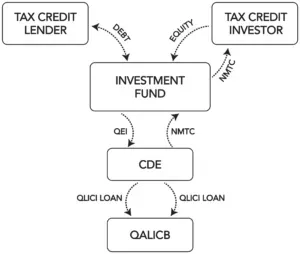
NMTC – The U.S. Treasury’s New Markets Tax Credit program (NMTC), which began in 2000, is designed to spur economic development activity in economically disadvantaged communities throughout the country. Communities often have good, viable business and economic development opportunities, but need access to capital. The NMTC addresses this capital gap by providing the incentive of a Federal tax credit to individuals or corporations that invest in a Community Development Entity (CDE), which in turn invests in the local Qualified Active Low Income Community Business (QALICB).
Key Terms:
CDE – Community Development Entity provides investment capital (NMTC Allocation) to eligible projects in low-income communities
QEI – Qualified Equity Investment is the total of the equity invested into a project
LIC – Low Income Community
QALICB – Qualified Low-Income Community Business is the project company
QLICI – Qualified Low-Income Community Investment is the amount invested by the CDE into the QALICB
Connect HERE to the CohnReznick NMTC interactive map
Historic and LIHTC Tax Credits
Exploring the myriad funding options for a project?
Should you use Low-Income Housing Tax Credits, Historic Tax Credits or EPA Brownfields funds – and what amount does the project qualify for?
Members of our team have decades of experience successfully procuring and managing Federal and state grant funding. Virtually all of the projects developed by our staff have utilized HUD CDBG, HUD HOME, Low Income Housing Tax Credits, and Federal Historic Tax Credits (if rehab), in addition to many other public and private grant sources.
Investment Historic Tax Credits White Paper
Overview: The Federal Historic Preservation Tax Incentives (HTC) program provides a 20% income tax credit for the rehabilitation of historic, income-producing buildings that are determined by the Secretary of the Interior, through the National Park Service, to be “certified historic structures.”
The State Historic Preservation Officer and the National Park Service review the rehabilitation work to ensure that it complies with the Secretary’s Standards for Rehabilitation.
The HTC is intended to leverage private investment in rehabilitation projects which are costlier and riskier than new construction—and thus harder to finance—but are important to the revitalization of a community. Developers typically transfer the historic tax credits to investors in exchange for equity.
Investor equity lowers the amount of debt that the developer needs to finance the project, while making lenders more comfortable with the property’s loan-to-value and the size of the loan needed. In this way, the tax credit effectively draws the private capital—both equity and debt—needed to make the project more feasible.
The table below shows the impact of HTC funding on a project.
Sources of Funds With HTC
NMTC Equity $ 5,405,112
Fed HTC Equity $ 2,499,171
State HTC Equity $ 614,500
Owner Equity $ 1,250,000
Hard Debt $ 6,082,454
Grants $ 834,000
Total $ 16,685,237
Sources of Funds Without HTC
NMTC Equity $ 5,405,112
Owner Equity $ 2,575,000
Hard Debt $ 7,870,000
Grants $ 834,000
Total $ 16,685,237
Low-Income Housing Tax Credit White Paper
A Source of Funding for affordable housing
Overview: The Low-Income Housing Tax Credit (LIHTC) provides a dollar-for-dollar reduction in federal tax liability over a 10-year period for owners of qualified rental housing projects who agree to specific operating restrictions over a 15-year period. LIHTCs are sold to investors for equity, which acts as a subsidy for the project, reducing the amount of debt that developers would otherwise need to incur. The program was created under the Tax Reform Act of 1986 and has developed over 3 million units of affordable housing since its inception.
LIHTCs as a Catalytic Tool: Most projects are structured as limited partnerships, affording the for-profit investor with limited liability while providing the non-profit managing general partner with day-to-day control of operations. As a result, LIHTC projects are true partnerships, bringing together equity investors with mission-driven housing developers. LIHTC properties tend to have lower debt service payments, lower vacancy rates, and quicker lease-up rates due to the presence of the subsidy. Well-maintained, stable, rent-restricted affordable housing projects are vital to economically vibrant downtowns, allowing those with less means to live in and benefit the community.
How LIHTCs Work
9% and 4% Credits: Projects that have substantial rehabilitation or new construction are eligible for 9% credits. The credit for each year of the 10-year period is approximately 9% of the qualified development costs, or the “present value” of 70% of the qualified costs over 10 years. 9% credits are allocated to each state based on population, and developers must apply for these credits annually. The 4% credit (30% present value) is available for building acquisition and minor rehabilitation and is an “automatic” credit not requiring application to an allocating authority.
Restricted Units: In general, projects need to designate at least 20% of their units for households at 50% of median family income (MFI), or at least 40% of their units for households at 60% MFI. The portion of the project that is not designated for low-income residents is not eligible for LIHTC.
Equity for Credits: Developers sell credits to investors in exchange for equity. There are essentially two types of LIHTC investors:
1) Financial Institutions: LIHTC investing complements a bank’s underwriting practices
for a real estate project. Banks also have goals under the Community Reinvestment Act (CRA),
which requires lenders to deploy capital in projects that primarily benefit low and moderate-income
neighborhoods.
2) Economic Investors: While financial institutions with no CRA needs may fall into this
category, these companies invest primarily for tax benefits. Thus, these investors are less
concerned with project location.
Developers can either sell credits directly to an investor, who then enters into a partnership to own the project as a limited partner or investor member, or the credits are syndicated. Syndicators are intermediary institutions that make investments in multi-fund or single/proprietary equity funds. The syndicator manages these funds, underwriting the project for the investor and performing asset management and regular reporting.
15-Year Compliance: Once the project is built, state allocating agencies must ensure that LIHTC eligibility requirements are met throughout the 15-year compliance period. Property owners must certify annually that units are rented to qualified low-income tenants. Non-compliance can trigger loss of credits for the limited partner/investor.
How Can LIHTCs Help Your Project?
Today, in 2018, LIHTCs are utilized in 90% of all affordable housing developments in the United States. A typical project can raise 40%-50% of capital needed through LIHTCs, with additional grants and below-market subsidies coming from e.g. HUD CDBG, HUD HOME, USDA Rural Development, Federal Historic Tax Credits, and the Federal Home Loan Bank Affordable Housing Program. Given such capital stacks, most LIHTC projects are able to minimize conventional debt, enabling lower rents and more robust replacement reserve set asides out of operations.
COMMUNITY LED REVITalization projects
M&S Development is a multi-disciplinary firm specializing in small industrial and community-led revitalization projects.
“The Bennington Redevelopment Group, and even more so the entire Bennington Community, cannot possibly thank you enough for sticking with us through this entire process to get to closing. You had every reason in the world to raise the white flag and call it quits. Yet you never once wavered, complained or did anything other than keep driving forward. There is no team I would rather have on my side than the team at M&S.” — Bill Colvin, Assistant Director and Community Development Program Coordinator for the Bennington County Regional Commission
Experience
Small industrial and community-led revitalization projects are our specialty. We provide the financial, design, and legal expertise necessary to guide a project to completion. With the ability to work closely with architects and engineers from our “sister” company, Stevens & Associates, we can function as an integrated design-development firm.
HV GS Precision
Our trademark is engaging directly with our client community by listening to the needs and possibilities presented, and leading each step of the complex process.
In 29 years of community development, team members of M&S Development have facilitated projects encompassing mixed-use downtown development, healthcare, commercial, light industrial, and affordable and market-rate housing.
Our understanding of the funding and financial packaging—combined with experienced legal, finance and design professionals all under one roof—can minimize fees and closing costs.
Project Success
We have built strong relationships with lenders, investors and New Markets Tax Credits CDEs by delivering credible and thoroughly researched projects.
Our members’ success stories include the creation of West River Valley Senior Housing, the Wilder Block rehabilitation, retention and expansion of GS Precision and Weidmann Electrical Technology, the redevelopment of the Brooks House, expansion of Brattleboro Memorial Hospital, the retention and expansion of Chroma Technology, and the development of Commonwealth Dairy. These projects have helped retain and create hundreds of jobs, commercial spaces and housing units, and produced significant direct and indirect economic benefits to their communities.
These projects illustrate the use of complex funding tranches which include tax credits, environmental mitigation funding, community development block grants, the use of private equity, Tax Incremental Financing (TIF), and varied loan and grant sources to make these vital projects possible in communities where redevelopment is not economically viable.
Efficiencies
Being a multi-discipline firm means that fewer people need to be in the room to ensure full communication among the team – and between the team and the project sponsor.
Continuity – the same team members are involved with the project from feasibility through financial closing, construction management, and compliance management.
Working with M&S Development means the local business’s management team does not have to carve significant time out of their schedules to manage the project.
At-Risk Pre-development Services
Our goal is to facilitate community redevelopment. To that end we often offer to share the risk with our client community and provide a fixed amount of pre-development financial feasibility work at-risk.
Contact us
Have a question? Send us a message and we’ll be in touch. Also, feel free to email us at info@msdevelopmentllc.com for Development Inquiries.